
How to Choose a Massage Therapist
How to check a Florida license, what training hours do and do not prove, and the questions worth asking a therapist before you book a session.
Most people pick a massage therapist off a map. Closest, open tonight, good reviews. However, I believe there should be more thought and care to choosing who is responsible for your body and its wellness.
Do you want to relax? Do you want deeper work? Do you want those stubborn knots taken care of? Whatever you are looking for, look for the specific work that you need and see if the reviews match.
What separates two therapists is whether the person working on you can find what is actually going on, and whether they will be straight with you about it.
A lot of my clients arrived after a run of sessions somewhere else that left them roughly where they started. The sessions were not bad. They just did not go anywhere.
That is not you being difficult or hard to treat. It usually means nobody went looking for the cause, and that is a fixable problem rather than something you have to live with.
You probably know the feeling, the dull ache, that sharp pain, or something has been nagging for a few weeks so you finally book. You leave loose and pleasantly oiled, and by Thursday the same shoulder is doing the same thing it was doing before you went.
So here is what I would look for.
A license is where you start, not where you finish
What a Florida license actually proves
Massage therapy is regulated here, and the requirements are public. The Florida Board of Massage Therapy requires a course of study at a board approved school of 500 or more clock hours, which includes a ten hour course in Florida laws and rules, and a passing score on the Massage and Bodywork Licensing Examination. My license is MA95829. The studio holds its own establishment license, MM46131, which is a separate requirement.
Regulation is not universal. The National Center for Complementary and Integrative Health counted 45 states and the District of Columbia as regulating massage therapy when it last updated that page in 2019. Florida is one of them.
Here is the part worth sitting with.
A license tells you someone cleared a minimum. It does not tell you they are good.
How to check one in about two minutes
Florida publishes its license records. Search a therapist by name on the Department of Health license verification portal and you will see the license number, whether it is clear and active, and when it expires. Search the business name as well, since an establishment carries its own license.
If a name does not come back, ask before you book. Usually there is an ordinary explanation, like a legal name that differs from the one on the door.
See the research
- Florida Board of Massage Therapy, requirements for applicants. A course of study at a board approved massage school of 500 or more clock hours, a ten-hour Florida Laws and Rules course, and a passing score on an approved exam such as the MBLEx.
- National Center for Complementary and Integrative Health, Massage Therapy: What You Need To Know. In states that regulate massage therapy (45 states and the District of Columbia), therapists must get a license or certification. Page last updated May 2019.
- Florida Department of Health, license verification. The free public search for any therapist (MA) or establishment (MM) license.
Training hours, and what they leave out
The 500 hour benchmark
Writing for the University of Minnesota’s Earl E. Bakken Center for Spirituality and Healing, Beth Burgan sets the same floor Florida does.
You should look for a massage therapist who has at least 500 hours of training from a reputable, accredited school.
That guidance sits on Taking Charge of Your Wellbeing. It is a floor rather than a target, and plenty of therapists carry several times that number.
What the hours do not cover
A curriculum teaches anatomy, contraindications, ethics, draping and a set of strokes. All of that matters and is very important to the profession. Finding is a separate skill, built over time, sometimes years, by paying attention to what comes back.
I trained at the Cortiva Institute about six years ago. On the day I finished I knew the anatomy, and the training that I received by the teachers only supplemented what I knew further and made me better at truly understanding the flow of the body.
What I had going in was that I learned to feel for the cause years before I learned the words for what I was feeling, which is a longer story on the about page. So when you are weighing someone, ask about the years and the settings they have worked in, not only the hours on the certificate.
See the research
- University of Minnesota, Taking Charge of Your Wellbeing, How Can I Find the Right Massage Therapist? Written by Beth Burgan, MA, MFA, and reviewed by Dale Healey, DC. The quote above is taken word for word from that page.
The questions worth asking before you book
What a real answer sounds like
Call, or send a message through the website. Three questions cover most of it.
- What do you work on most often?
- Have you worked with this specific thing before, and what happened?
- What would you do in a first session with me?
A useful answer is specific and usually contains a limit. Yes, that pattern is common, here is what I would look at first, and here is the part I would want you to see someone else about.
Here is a real one. You have what feels like pain deep inside your shoulder. It is a bit achy, sharp when you lift it up to a specific point, and definitely painful to move freely. I would personally address the musculature around the area, calm down the pain and reduce the tension.
We would look at the upper trapezius, the front, lateral and rear deltoids, the teres major and minor, and the subscapularis if applicable. We would also go through a range of stretches to ease your nervous system into feeling more safe and comfortable in the ranges of motion you were not able to move into before.
An answer that fits any body and any complaint is not really an answer, it must be backed by understanding and experience. If someone says every session is customized to your needs, they must know how to properly explore the tension and muscles that are affecting you.
Then ask what happens if one area needs the whole hour. The reply tells you whether the session is built around you or around a template. There are more questions like these on the FAQ page.
What the first session tells you
Being asked, and then being listened to
Intake should feel like a conversation rather than a form. What hurts, how long, what makes it worse, what you have already tried. In the American Massage Therapy Association’s 2026 profession research, 49 percent of people who get a massage do so for soreness, stiffness or spasm and 42 percent for chronic pain relief and management. Most of the room came in because something hurts, so a therapist who does not ask is choosing not to know.
The second half of that is whether what you said comes back. If you mention that your left hip has been the problem since February, and the session runs a standard route with a few extra minutes at the end on that problem area, you were heard but not listened to. That is not what we do here.
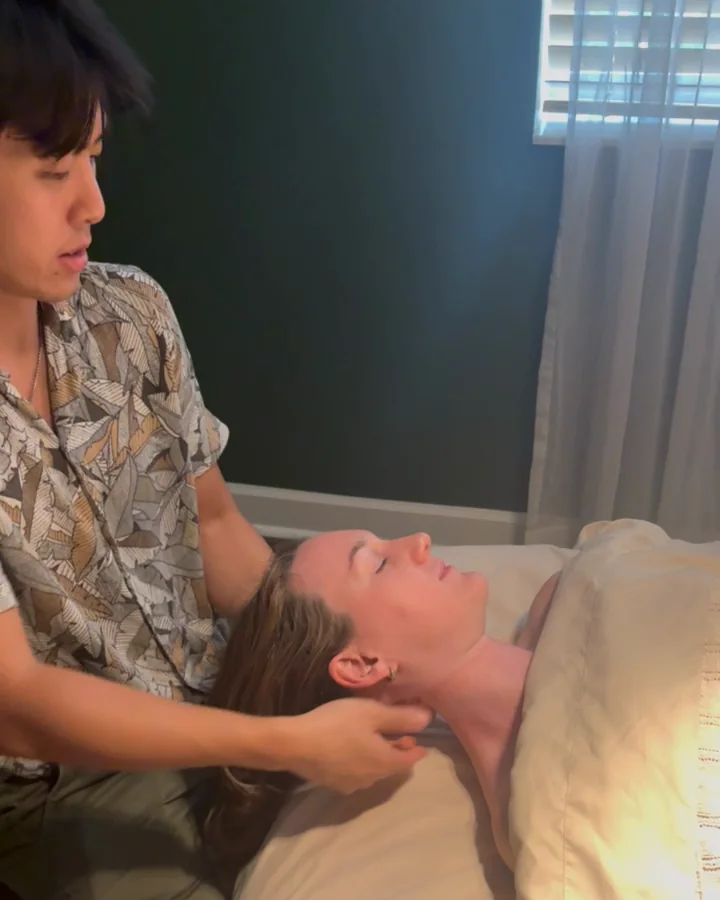
Pressure, and whether anyone asks you about it
You should be asked about pressure early, and asked again once the work has started. Firmer is not better. Pressure that makes you brace works against itself, because a guarded muscle does not release.
This is also where the name on the menu matters less than most people think. A relaxation session and deep tissue work are different intentions rather than different amounts of force. Here those are Relax and Soothe, your relaxation and more Swedish focused massage, and Pressure and Relief, deep tissue focused bodywork.
Focused work on one stubborn area (The Hands) can involve less pressure than either. So can neck, shoulder and scalp work (Head and Neck Relief). All four are described on the services page at the same flat rate, 100 dollars for sixty minutes, 150 for ninety and 200 for two hours.
See the research
- American Massage Therapy Association, Massage Profession Fact Sheet, based on AMTA's 2026 Massage Profession Research Report. The top reasons consumers got a massage were soreness, stiffness or spasm (49 percent) and chronic pain relief and management (42 percent).
Recommendations, and the answer that tells you the most
Where referrals actually come from
The strongest recommendation is still someone you know describing a specific problem that got better. Professional referrals are worth weighing too. The same AMTA 2026 research found that 64 percent of massage therapists report referrals from other healthcare professionals and 60 percent from chiropractic offices. In AMTA’s 2025 consumer survey of 1,000 adults, 22 percent of the people who talked about massage with their doctor or other provider were referred to a therapist.
If you already see a physical therapist or a chiropractor, ask who they send people to. They watch the results come back.
When a therapist should tell you no
Massage is generally low risk. NCCIH puts it this way.
The risk of harmful effects from massage therapy appears to be low. However, there have been rare reports of serious side effects, such as a blood clot, nerve injury, or bone fracture.
Low risk is not no risk, and there are situations where the right answer is to wait, or to see someone else first. A therapist who has never told anyone that is either very lucky or not paying attention.
I will tell you when something is outside what I can address, and when I can only work the symptom rather than the cause. Saying so costs me a booking. It is still the right call, and it is the single thing I would listen hardest for when choosing anyone.
See the research
- AMTA Massage Profession Fact Sheet (2026 research). Top referral sources for massage therapists are other massage therapists (74 percent), other healthcare professionals (64 percent) and chiropractic offices (60 percent).
- AMTA, Consumer Views and Use of Massage Therapy. An online survey of a representative US sample of 1,000 adults, July 11 to 13, 2025. Of consumers who discussed massage therapy with their doctor or medical provider, 22 percent were referred to a massage therapist.
- NCCIH, Massage Therapy: What You Need To Know. The safety quote above is taken word for word from that page.
Heather H. found her way here after a long search and put it like this on my Google page.
I have been on the search for a massage therapist who “gets it” and Huan is the guy!
That is what you are looking for, from whoever you end up choosing. You do not need a diagnosis or a bad week to be worth an hour of someone’s full attention, and you should not have to make the case for it.
If you want to ask before you book, the contact page reaches me directly, and everything else runs through the online schedule. For the fastest response, call or text 813.797.0406.
Frequently asked questions
How do I check whether a massage therapist is licensed in Florida?
Search their name on the Florida Department of Health license verification portal. You will see the license number, the status and the expiration date. Search the business name as well, because a massage establishment holds a separate license from the therapist working inside it.
What is the difference between an MA and an MM license number?
MA is the individual massage therapist license. MM is the establishment license held by the place of business. A studio should be able to show you both without hesitating.
How many hours of training does a massage therapist need?
Florida requires 500 or more clock hours at a board approved school, including a ten hour laws and rules course, plus the licensing exam. Guidance from the University of Minnesota’s Taking Charge of Your Wellbeing sets the same 500 hour floor. Many therapists carry far more, and years of practice usually matter more than the number on the certificate.
Should I book a relaxation massage or a deep tissue massage?
Describe what hurts and how long it has been going on, and let the therapist tell you. If you are torn, book sixty minutes of either and adjust once you are in the room. The intention matters more than the label.
Is it rude to ask a massage therapist about their experience?
No. It is the most useful thing you can do before booking, and a therapist who is uncomfortable answering has told you something worth knowing.
Will I see the same therapist every time?
Yes. I work alone, so the hands on your back are the same hands at every visit. Someone who has worked on you a dozen times is not starting from scratch, and you are not re-explaining yourself at each appointment.