
When Massage Is Not the Answer
When not to get a massage, what the safety research says, and when to see a doctor first. Where my work stops, from a licensed therapist in Westchase, Tampa.
The most valuable thing I can offer you is an honest answer, and once in a while the honest answer is that what you are describing should be looked at by a specialist before anyone puts hands on it.
It does not happen often. Usually someone describes what is going on, I listen, and we can work the symptoms that are making the day uncomfortable and then see how things sit afterwards. Now and then the picture is different, and the right thing is to say so and point them toward the person who can actually look at it.
This post is about where that line sits, because I would rather you knew before you booked than found out afterwards.
Why I would rather tell you
What saying it costs me
A session is a hundred dollars and I run this practice on my own, so turning one away is not free, and I will do it anyway. The clients who have stayed with me longest since I opened in 2023 are mostly the ones I was straight with early, including the ones I sent elsewhere first.
Trust is the whole business. It does not survive one hour that both of us had a feeling was not going to help as much as we had thought. However, it is always worth a shot to at least rule out the muscular portion of it.
You have probably had the other version
You describe the problem, nobody quite takes it in, and you get the standard hour anyway. Then you book somewhere else and describe it again, and the same thing happens. After a while you stop explaining properly, because explaining has not changed what you get, and that is truly frustrating. By the time you walk into a new room you are half expecting to be processed rather than heard.
That is the thing I am trying not to do to you. You will be heard here, and you will get a straight answer about what I can and cannot reach.
Where my work stops
When the pain is carrying information
Some symptoms are not a tightness to be worked on. They are a signal, and the right response is a physician rather than a massage therapist. Cleveland Clinic lists several in its guidance on when back pain needs a doctor, including new numbness or tingling in an arm or a leg that was not there before, new weakness in an arm or a leg, and any loss of control of your bowels or bladder. Pain severe enough that you can no longer walk is an emergency rather than an appointment.
If you tell me any of that, I would not put you on the table. I will tell you why and I will tell you to get it looked at.
When something needs clearance first
There is a second group, where massage may well be fine but the decision is not mine to make alone. Mayo Clinic suggests talking with your healthcare team first if you have recently had a heart attack, have a bleeding disorder, take blood thinning medicine, have recently had a blood clot in your leg, or have burns, broken bones or severe osteoporosis. It also notes that pregnancy and your own health history both bear on what is safe, that massage is generally not done directly on tumors, and that pressure should be kept off healing wounds and areas with nerve damage.
None of that means you cannot have bodywork. It means the conversation starts with your doctor rather than with my booking page.
See the research
- Cleveland Clinic, When to see a doctor for back pain. See a healthcare provider if back pain comes with new numbness or tingling in an arm or a leg, new weakness in an arm or a leg, or loss of control of your bowels or bladder. If the pain is so severe that you can no longer walk, consider the emergency room instead.
- Mayo Clinic, Massage therapy. Talk with your healthcare team first after a recent heart attack, with a bleeding disorder, on blood-thinning medicine, after a recent blood clot in your leg, or with burns, broken bones or severe osteoporosis. Massage generally is not done directly on tumors, and pressure should be avoided on healing wounds or nerve damage. Safety can depend on your health history and current conditions, including pregnancy.
What the safety research actually says
The short version, and it is reassuring
The National Center for Complementary and Integrative Health states the position plainly.
The risk of harmful effects from massage therapy appears to be low.
The same agency notes that there have been rare reports of serious side effects such as a blood clot, a nerve injury or a bone fracture, and that some of those reported cases involved vigorous forms of the work, deep tissue among them, or people already at higher risk of injury. That is not an argument against depth. It is an argument for depth applied by someone who is paying attention to the person underneath it.
Where that evidence is thin
Mayo Clinic pairs its own safety statement with a caveat worth repeating, which is that serious side effects are rare but the evidence base is limited and more study is needed.
So the honest summary is that this is low risk work with a research base too thin to call it no risk. NCCIH puts the practical conclusion in one sentence, and it is the sentence this whole post is built around.
Don’t use massage therapy to postpone seeing a health care provider about a medical problem.
See the research
- NCCIH, Massage Therapy: What You Need To Know. Both quotes above are word for word from that page. It adds that some reported cases of serious side effects involved vigorous types of massage, such as deep tissue massage, or patients who might be at increased risk of injury, such as elderly people.
- Mayo Clinic, Massage therapy. Research shows that serious side effects are rare, but more studies are needed as evidence is limited.
However, when it comes to lived experience, I would rather let a client put it. Luis C. wrote on my Google page that I
explains whats happening throughout the process
Telling you what I am finding includes telling you when it is not mine to work on. Most people who come in are carrying ordinary accumulated tension, and for them the question of risk barely arises. If that is you, none of the above is about you, and an hour is simply an hour well spent.
How this goes in the room
What I will actually say
I will tell you what I am hearing, I will tell you plainly that I do not think this is mine to solve, and I will say who I would see instead. Usually that is a physician, sometimes a physical therapist, occasionally an imaging appointment before anything else happens.
I am not diagnosing you when I do that. I am not qualified to and I will not pretend otherwise. I am telling you that what you have described sits outside what my hands can address, which is a different statement and a much safer one.
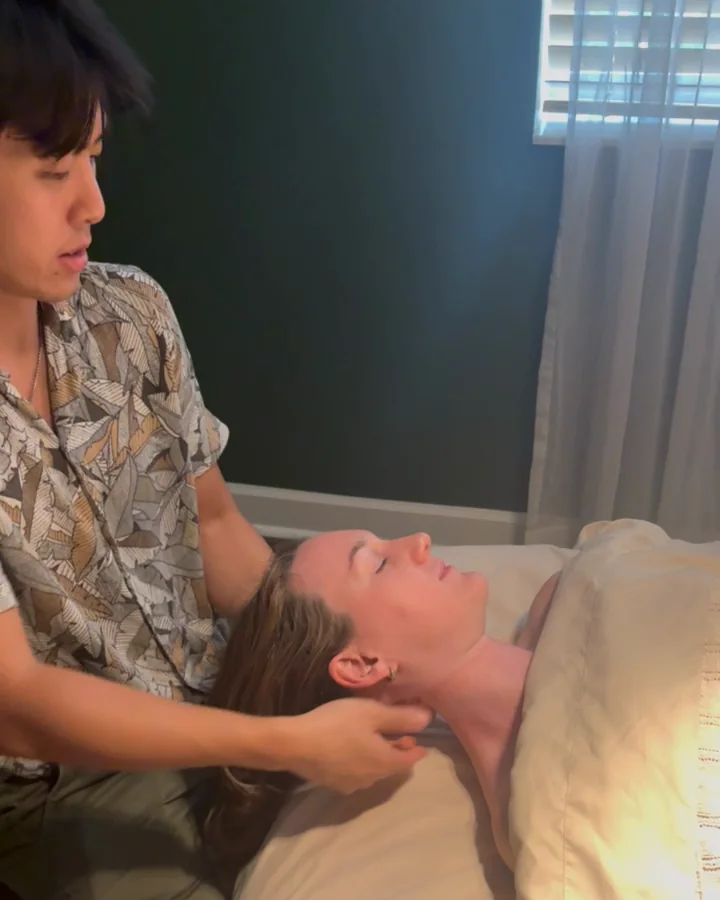
Massage therapy also sits closer to the rest of healthcare than people assume. In the American Massage Therapy Association’s 2026 profession research, 64 percent of massage therapists report receiving referrals from other healthcare professionals and 60 percent from chiropractic offices. The traffic runs both ways, and it should.
What I can do while you sort out the rest
Being told that massage is not the answer to one thing does not mean there is nothing here for you. Often the original problem belongs to a doctor and the guarding that has built up around it over six months belongs to me. Those are two separate pieces of work, and they can run alongside each other once someone has looked at the first one.
In that same association’s 2025 consumer survey, fielded among 1,000 adults in July 2025, 22 percent of people who had discussed massage with a doctor said the doctor referred them to a massage therapist. That is the version of this I like best. Somebody looked first, and then sent them on.
See the research
- AMTA Massage Profession Fact Sheet, based on the 2026 Massage Profession Research Report. Top referral sources for massage therapists include other healthcare professionals (64 percent) and chiropractic offices (60 percent).
- AMTA, Consumer Views and Use of Massage Therapy. An online survey of a representative US sample of 1,000 adults, July 11 to 13, 2025. Of consumers who discussed massage therapy with their doctor or medical provider, 22 percent were referred to a massage therapist.
If you are not sure which side of the line you are on, say so before you book. The contact page reaches me directly and I will tell you honestly, including when the answer is that you want somebody else. There is more on how I work on the about page, and a walkthrough of a first session on the page about what to expect on your first visit.
For the fastest response, call or text 813.797.0406.
Frequently asked questions
Will you tell me to see a doctor just to be safe?
Only when I think it matters. I am not going to send you away over an ordinary stiff neck. If what you describe includes something that belongs with a physician, I will tell you and leave the decision with you.
Can I still book if I have a medical condition?
In most cases yes, and the thing that makes it work is telling me about it. Mention anything you are being treated for, any medication you take and anything your doctor has said about activity. If your situation is on the list above, have the conversation with them first.
Should massage ever be painful?
Deep work can be intense and it should stay workable. Mayo Clinic’s position is that you should not feel severe pain during a massage, and mine is the same. Pressure that makes you hold your breath is pressure I should be easing off.
What if I am already seeing a physical therapist or a chiropractor?
That is common and it is usually fine. Tell me what they are working on and what they have asked you to do, and I will work around it rather than across it. If something they have told you contradicts something I am doing, theirs wins.
How do I ask before booking?
The contact page reaches me directly, and the FAQ page covers most of the questions that come up first. If you would rather just book, everything runs through the online schedule.