
Why I Build Fifteen Minutes Into Every Session
Every session carries fifteen extra minutes you do not pay for. What they are for, what happens if you run late, and what a study found on 30 vs 60 minutes.
You have probably had this hour where the work was good, or good enough, and then a hand lifts off your back and someone tells you the time is up. You sit up while you are still somewhere else. You dress quickly, you pay at a counter with the next person already waiting in the hallway, and by the time you are back in the car you are still catching up with yourself, because the whole thing rushed past you at the end.
Every appointment I book carries fifteen minutes beyond the hour you pay for. I have never explained that anywhere a client could read it, which is my own oversight, so here is what those minutes are and what they are for.
What the fifteen minutes actually is
Where it sits around the hour
The fifteen minutes is space between appointments. It is not a portion of your session and it is not time taken out of the work. Book sixty minutes of deep tissue work (Pressure and Relief) and you get sixty minutes of hands on work. The buffer sits on either side of that hour so nothing has to be hurried at the start or cut short at the end unless you are severely late.
In practical terms it means I am not booking a client at the top of every hour. Two appointments in a day cost me the same room time as two and a half, and that is something that you deserve and I need for myself.
Why you should not feel the clock
Most people can tell when a therapist is watching the time. The pressure changes in the last few minutes, the pace picks up, and the finish has a hurry in it. I would rather you never have that information or feel it.
I do not lift my hands at minute fifty nine.
Why the buffer exists
Everyday life does not keep to a schedule
Traffic on the way here. A school pickup that ran long. A call that would not end. People arrive ten minutes after their start time and walk in apologizing, and really it is okay. We all have lives, we are all busy parents and adults. You cannot plan for everything that may creep up.
That is what the buffer absorbs. Life gets unpredictable, and solving that for my calendar is not your job. You are not going to be met at the door with a problem.
The conversation that has to happen first
Before I put hands on anyone I want to know what hurts, how long it has been going on, what you have already tried, and what you believe is causing it. That last question matters more than people expect. I always work the area you tell me hurts, even when I think the cause sits somewhere else, because your pain deserves to be acknowledged before it gets explained.
Finding the spot takes real time, and I learned that from my grandmother, which is a longer story on the about page. If that conversation came out of your hour, it would get shorter every visit, and the work would get worse with it.
What the research says about time on the table
A trial that tested session length directly
In 2014 a team led by Karen Sherman at the Group Health Research Institute published a dosing trial in Annals of Family Medicine. They enrolled 228 adults with chronic neck pain and divided them across six groups, testing thirty minute sessions two and three times weekly, sixty minute sessions one, two and three times weekly, and a wait list that received nothing. The National Center for Complementary and Alternative Medicine funded the work.
The thirty minute sessions were not significantly better than the wait list at either frequency. The sixty minute sessions given twice and three times weekly did produce clinically meaningful improvement. People in those groups were about three and five times as likely as the wait list to improve in neck function, and between two and three times as likely to improve in pain intensity. Sherman, an affiliate professor of epidemiology at the University of Washington School of Public Health, put it plainly.
Our results suggest that multiple 60-minute massages per week are more effective.
What that trial cannot tell you
The authors named their own limits, and they are worth repeating. Modest sample sizes in each group. A wait list design that cannot separate the treatment from the attention that came with it. Participants whose neck pain was mostly mild to moderate. Short term follow up only. Reviewing this whole body of literature, the National Center for Complementary and Integrative Health still reports that the “effectiveness of massage for neck pain remains uncertain.”
So I am not going to tell you that research proves an hour works and half an hour does not. One trial in one condition is not a rule, and I would rather say that than overstate what is known.
See the research
- Sherman and colleagues, Annals of Family Medicine, March 2014, 12(2):112 to 120. 228 people with chronic nonspecific neck pain, randomized to 30 minute visits 2 or 3 times weekly, 60 minute visits 1, 2 or 3 times weekly, or a 4 week wait list. Thirty minute visits were not significantly better than the wait list. Sixty minute visits 2 and 3 times weekly raised the chance of meaningful improvement in neck function (relative risk 3.41 and 4.98) and in pain (2.30 and 2.73). Funded by the National Center for Complementary and Alternative Medicine, grant R01 AT004411.
- University of Washington School of Public Health, news release. The quote above, from lead author Dr. Karen Sherman, affiliate professor of epidemiology at the UW School of Public Health and senior scientific investigator at Group Health.
- NCCIH, Massage Therapy for Health: What the Science Says. The page concludes that no recommendations for practice can be made at this time because the effectiveness of massage for neck pain remains uncertain.
Nobody has ever told me their session ran too long. What they notice is the part at the start. Gareth M. wrote this on my Google page.
took the time to ask me about my needs
That takes minutes, and those minutes have to come from somewhere.
The end of a session is part of the session
Take your time
When the work is done I say the same thing every time. Take your time. The room stays yours, and you get up when you are ready rather than when the door opens. Some people sit on the edge of the table for five minutes and say nothing at all, and that is often the most useful five minutes of the hour.
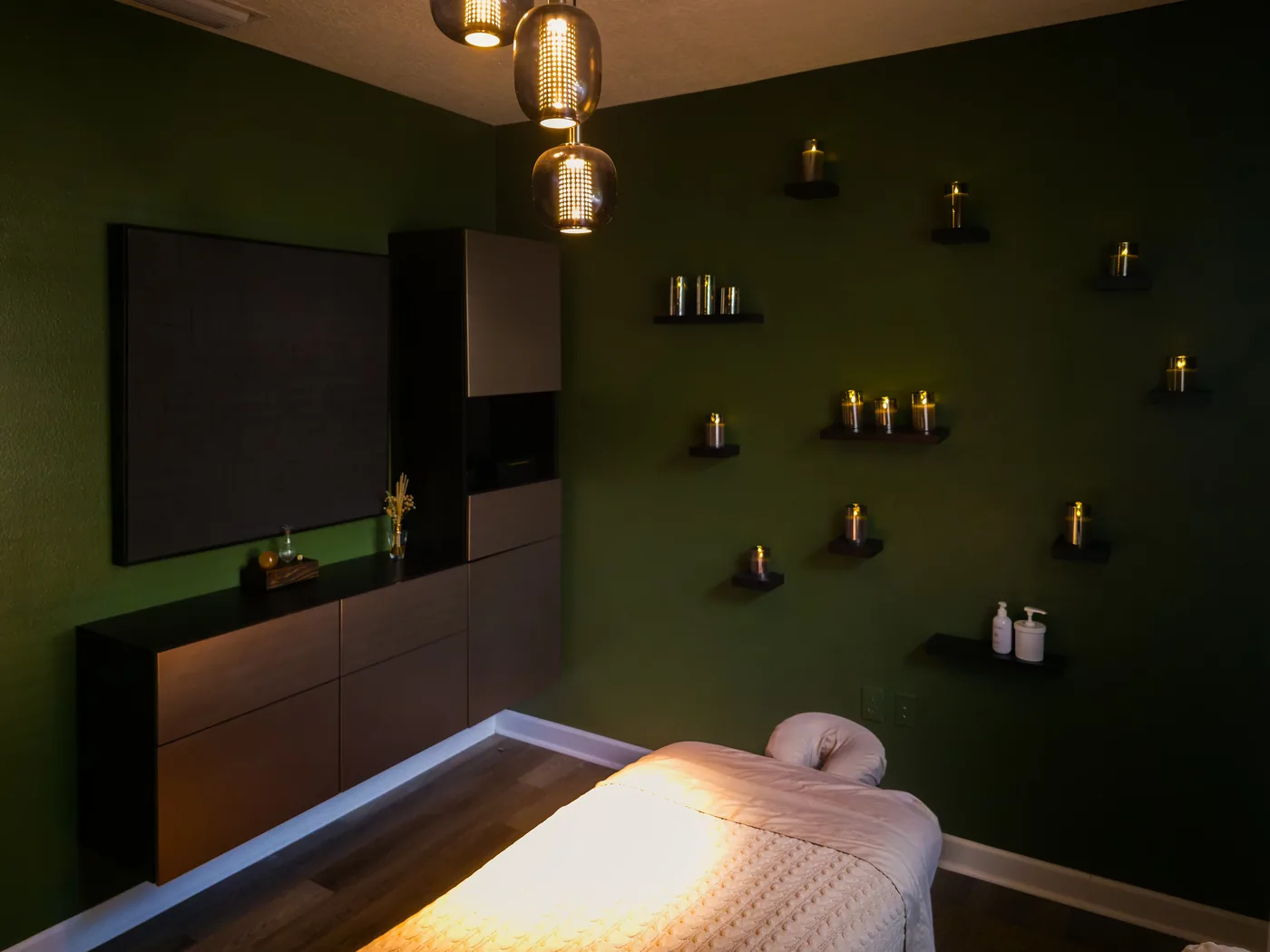
The finish also includes a magnesium oil application across whatever we worked on, which I call the reset. It takes a couple of minutes. If the hour were all the time I had, it would be the first thing to go, and the part of the session people mention to me most would quietly disappear. There is more about how I came to work this way on the about page.
What this means for the session you book
Fewer than three sessions a year
The American Massage Therapy Association runs an annual consumer survey, fielded by Big Village among 1,000 US adults in July 2025. It found that people who get massage received an average of 2.7 of them in the past twelve months, and that 71 percent had used massage for a health or medical reason in the twelve months ending June 2025. In the association’s 2026 profession research, 49 percent of clients name soreness, stiffness or spasm as their reason for coming in and 42 percent name chronic pain relief and management.
Read those two together and a picture appears. Most people are bringing a real physical problem to fewer than three appointments a year. Compress one of those three at both ends and a meaningful share of the year’s care goes to somebody’s schedule instead of to the body on the table.
See the research
- AMTA, Consumer Views and Use of Massage Therapy. An online survey by Big Village of a representative US sample of 1,000 adults, July 11 to 13, 2025. Consumers received an average of 2.7 massages in the past 12 months, and 71 percent of massage consumers used massage for a health or medical reason in the 12 months ending June 2025.
- AMTA Massage Profession Fact Sheet, based on the 2026 Massage Profession Research Report. The top reasons consumers got a massage were soreness, stiffness or spasm (49 percent) and chronic pain relief and management (42 percent).
Sixty, ninety, or a hundred and twenty minutes
Every session runs the same flat rate, 100 dollars for sixty minutes, 150 for ninety and 200 for two hours, across all four sessions. The buffer is identical no matter which one you book. If this will be your first visit, the whole hour is laid out here, and there is more on picking a length in the post on 60, 90 or 120 minutes.
If you are carrying something that has been there for months, the honest recommendation is ninety rather than sixty, and that has nothing to do with the buffer. More time on the table is simply more time working, and if sixty is what you have, book sixty. I would rather see you for an hour than not see you at all, and you do not need a reason beyond wanting the hour.
Frequently asked questions
Am I paying for the fifteen minutes?
No. You pay for the session length you book. The buffer is time I hold on my own calendar so your hour does not have to carry anything else.
What happens if I arrive late?
You still get your full session wherever possible, and you do not need to apologize for it. This is the situation the buffer was built for. If you are running very late, a text ahead of time helps me plan the room, though it is not required.
Does the buffer mean my sixty minute session is shorter than sixty minutes?
Always the opposite. Sixty minutes booked is sixty minutes of hands on work. The buffer sits outside it.
Can two of us book back to back?
Yes, and it is worth telling me when you book so I can hold the room properly. The buffer between the two appointments stays in place either way. More answers to questions like this sit on the FAQ page.
Should I book ninety minutes instead of sixty?
If the problem is long standing, or if there is more than one area you want addressed, ninety gives the work somewhere to go. For a single area, or for a first visit, sixty is a reasonable place to start.
How do I book?
Everything runs through the online schedule. If you would rather ask something before you commit to a time, the contact page reaches me directly. For the fastest response, call or text 813.797.0406.